Saturday, 11 March 2017

Meet the Achaeans

This post I had intended to highlight our play-testing for WorLard III. Unfortunately, the batteries ran out on my camera after just one shot! On the plus side, with that one quick snap, I did manage to get a picture of the club's rather nice model of Troy, which will form a splendid backdrop to our game.

Troy

With only two more club nights before WorLard (gulp!) we really need to be finishing off now. Fortunately, the rules seem to be coming together quite nicely with only a few issues yet to fix. I guess we will only really know on the day but they have already given some entertaining club games so they are at least looking promising.
Figure wise we have Matt's magnificent collection of Foundry Trojan Wars figures to fall back on, which should ease the pressure off Jim's painting schedule. My Achaeans are now complete so at least that's one side sorted. With that in mind let's take a closer look at the Achaean army.

At the moment the Achaean army will be lead by three 'Heroes'. Ultimately, I will give these appropriate names but for now we're going with names from the Iliad. Hopefully, using names that most players should recognise will add a bit of colour to the proceedings. So here we see Agamemnon, Achilles and Meneleus; accompanied by an unamed Hero as a Force Morale marker. In my head I see the morale marker as Agamemnon but I suppose we could call him Nestor for the day.

Achaean command


Much of the time our Heroes will be swanning about the battlefield on their chariots. At the moment I have no plans for an actual chariot force for the Achaeans but the Trojans will get one for the day. On the down side, if this works, I may eventually have to buy some more chariots! I will probably detail my rationale for this and my version of Homeric warfare in a later post.

Achaean mounted command


Mycenaean warrior vase
Sea People


Most of the fighting in the Iliad appears to consist of throwing spears. Hence, the bulk of the army will consist of spearmen. I've gone for figures that have a Late Bronze Age look based  upon the Mycenaean warrior vase and the Egyptian depictions of the Sea Peoples.


Warlord Achaeans
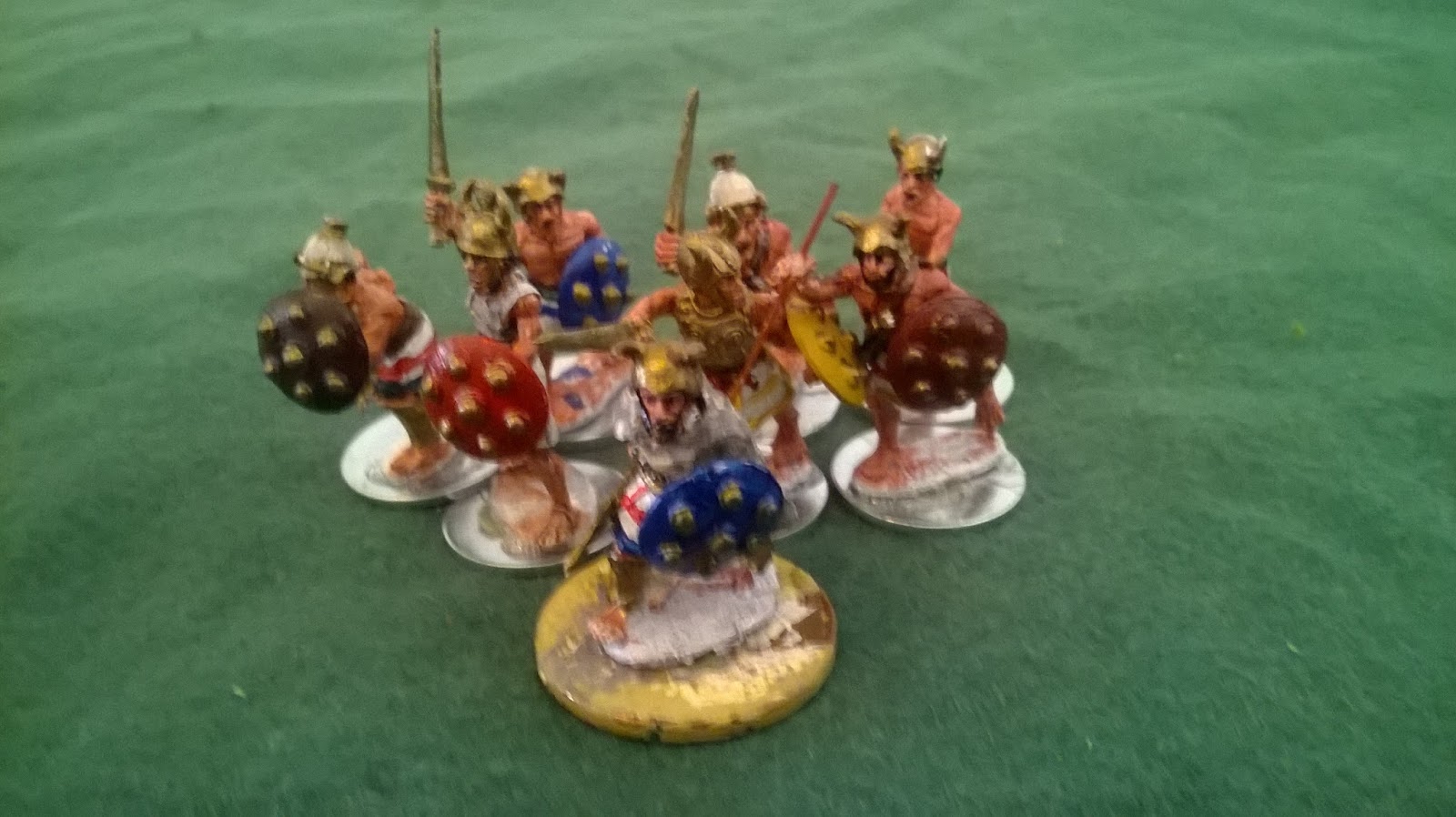
There doesn't seem to be any differentiation between armoured and unarmoured units, in the Iliad, so all units will consist of a mixture. The bulk of my figures are from the Warlord Achaean and Sea People ranges with a few Foundry sculpts thrown in. Below we see a typical group of Achaean spearmen. I have four such groups.


Newline & Foundry


I've tried to keep the slightly larger figures in separate groups, so here we see a mixture of Newline and Foundry figures. I have one such group, although I suspect I might replace these with Warlord figures eventually.


Achaeans with Dipylon shield

It is also clear, from the Iliad, that some of the Achaeans were a cut above the rest; 'elites' if you like. The troops led by Ajax and especially Achilles being a prime example. Hence, I have 2 groups of 'elites' in my force.


Achaeans with Dipylon shield


It helps to have distinctive looking figures so that the 'elites' can be easily distinguished. For this reason I have gone for troops with the so-called Dipylon shield. I was dubious about this at first as the evidence for this shield type in the Late Bronze Age is a bit thin on the ground but it does remain a possibility and is nicely distinctive.


Spot the Myrmidon


There is a school of thought that the Dipylon shield developed into the later Boeotian shield, which looks a lot like the shields carried by the Myrmidons in the film Troy. Hence, my 'elites' will of course be Myrmidons.


Newline archers
Last but not least we have the archers. These represent contingents such as the Locrians but should really be a mix of slingers and archers. The only slingers I could find were au naturale, as depicted in early Mycenaean art, but troops with tackle out didn't really fit with the intended look so I stuck with bowmen.

Warlord don't do archers so these are Newline; the Foundry version are also very nice. I have two groups of 6 archers but I am only fielding one group at the moment. The extra figures will allow me to use units of mixed spear and bow but that is for a future development.


shock markers (Warbases casualty dials)


And finally, we have the shock markers and yes the rules do generate a lot of shock!


So there we have it, the Achaeans currently stand at 3 Heroes with chariots, 2 groups of Myrmidons, 5 groups of spearmen and 1 group of archers.

I have a few ideas on how to improve these but lets get the Trojans done first. With a bit of luck I hope to have made a good start on these by April; ready to face Uriah's Sea People.

Captain von Wießmehr's triumph at Fim de Bunda

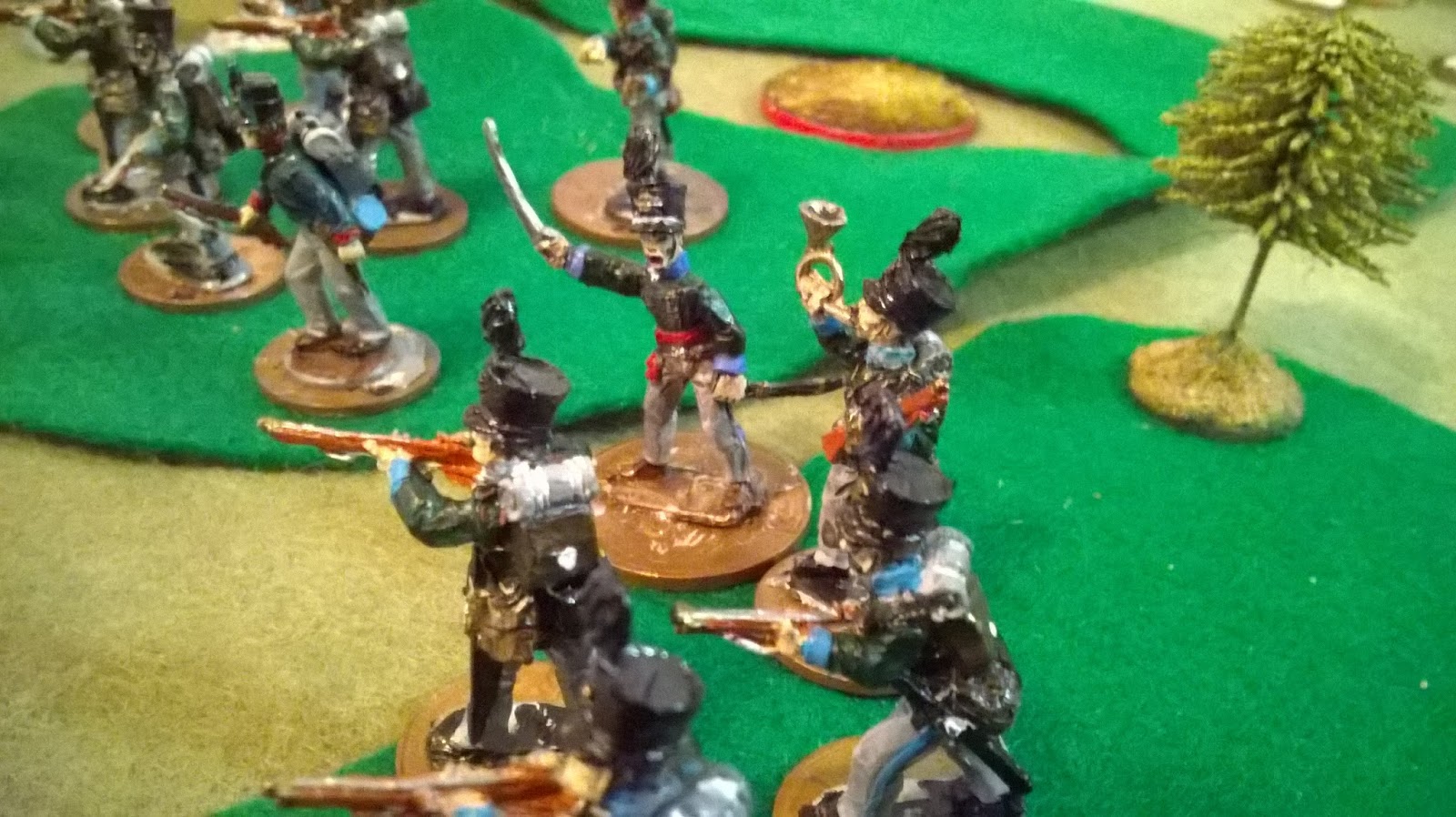
Gilesgate Publishing's "Idiot's Guide to Portugal" calls Fim de Bunda "a picturesque native village, unfortunately named."  (Literally it means "the arse end")  The guide continues... "however this was the scene of a desperate struggle during the Peninsular war, when in August 1808 the 60th Rifles fought an aggressive and ultimately triumphant battle against the 27th du Ligne, who were acting as General Delaborde's rearguard on his retreat from the field of Rolica."


The 60th rifles had the following plan of the battlefield, drawn up by their sinister and somewhat scary Exploring Officer.

I had a few issues to do with terrain, since I wanted to use my 28mm figures for this game, and my Peninsular project is very much in it's early stages.  I had been making some walled gardens, and indeed they can be seen in the photograph of the battlefield proper, but it turned out that the damned rendering was still wet so I couldn`t use them.  


The second building was my privy.  Every village should have one! I fudged the third building by using some walls and the large gate.  I really must get back to creating more buildings!

The Captain`s orders were for a straight-forward attack, down the left flank.


 So! I ended up on the Torres Vedras road after all. Typical bureaucratic cock-up - not surprised.
Right, let's crack on and get stuck into these Frenchies.

Deployment point in the middle of the edge of the three small gardens tile. Secondary point as far forward as possible from that.

Speed is the object here, shock and awe.
All three skirmish groups to occupy the two small buildings and environs and cover advance of the three line groups at pace along same side of the road.
If the Count of Pantyloons complains then he'll find himself swivelling on the end of me boot! What an absolute shower.

 The game ran like clockwork.  I had planned to use the French in two halves, either side of the road. 

Lieutenant Brûlé to the left. Major Finguin to the right.
The French defend their Officer, who is hiding in the privy.

The Captain has lost none of his skills.


Lieutenant Brûlé  emerges from the privy, a happier man...

The Wachtmiester leads some skirmishers to engage the French left.

Sergeant Feringno leads a group to support the Captain

The Count of Pantalones and his body servant Acmet arrive on the field.

The Captain drives off the French skirmishers and pushes up to the Privy.  Where did that French Officer go?

The 60th Rifles begin to take down the French Group.  Brûlé has been killed, or perhaps retreated back into the Privy!

The Major attempts to hold on the French left

Binky pushes his own group up, supprioted bt the Wachtmiester.

Binky triumphantly volleys and charges

The French run for it

The end game.

The Count is unhappy to have missed the fighting, and has to wait for his turn in the privy.

As night falls a Staff officer turns up at the battlefield.  None other than Sir Augustus Farthingdale himself...
"Ah Qwinthy, what are you doing on this woad old chap?  You are meant to be over therwe ain`t you?  Ah well nevwer mind.  Splendid job."
With that he rides off towards Captain Quilp.


Friday, 10 March 2017

18th August 1808, Evening, Dawns and Departures

18th August 1808, Dawns and Departures
The first moves towards Vimeiro

From Captain Quilp 4th Foot

I’ve chosen my support points as follows:
Exploring Officer @ 3 points
Secondary Deployment Point @ 2 points
Musician @ 1 point

I was tempted by a Physic but I reckoned the Priest could probably double for some of those duties. Hopefully, the Exploring Officer should increase my chances of finding the Frogs, and as I’ve plumped for the Exploring Officer I may as well take a Secondary Deployment Point as well so he has some effect on any resulting table top actions. Some may think the musician is for extra command and control but it’s actually for the camp; a spot of music means I won’t have to listen to the Priest and his sermons around the camp fire!

I don’t know how often you will be requiring orders but the general intent is to march straight down the Torre Vedras road. As Vimeiro Hill is at least 3 days away I need to push on if I’m to get there by the 21st. So the initial plan is to move on down the road as far as Ventosa, here I will leave the road and move on to Vimeiro Hill. Naturally I will have an infantry patrol one square ahead of my main body. The Exploring Officer will scout out the area between the 2 roads.

Toodle Pip,

Quilp (Light Company 4th Foot)

From Captain Wiessmehr,
60th Rifles:

(Through gritted teeth) "My dear Colonel Trant I look forward to meeting The Count of Pantalones and marching with him and his brave men." sotto voce "Gott helfe uns!"

Nobody is quite sure what happened to Binky in Quinta Gruga but he emerged after two days in Madame Lola's with a fierce grin, several bottles of Portuguese brandy and a repertoire of bawdy songs. The men's estimation of him has gone up considerably. Upgrade to Level 2.

The exploits of Corporal Louis Ferrigno at the convent where he broke down a door and then used it as a weapon had to be seen to be believed. The men know better than to make him angry and I am of the opinion that he will make a good sergeant, although Feuct thinks he is a little green.

Order of march on the road to Vimeiro.

Send The Masked Shadow out ahead. You know, I swear I've never seen that man blink.

Three skirmish groups with one sergeant each come next.

Then the three line groups with Lt. Snetterton -Lewis.

I shall accompany the last group with Dr Ottershaw, young Billy and the mules.

Finally, and with the VERY important duty of rear guard don’t y’know, the Portuguese and the blessed Count.


Red Force
The march from Quinta Gruga goes well, with the road south being empty.  You send forward patrols and the exploring Officer.  The fellow assigned to you is a Dragoon officer named David, the Lord Farthingdale.  He insists on that "the lord" title by the way.  He is a lieutenant and he is clearly drunk.  His father is Sir Augustus, a Staff Officer with Sir Arthur.
The route ahead is over scrub land that passes for cultivation here in Portugal.  Your patrols quickly push on and out of sight.  The exploring Officer is well mounted on an enormous stallion he calls Satan`s Balls.  He ranges ahead quite fearlessly and in the  afternoon reports the presence of French skirmishers from a line regiment in the area of St Paulo, a tiny village with a small church.  These Voltiguers are escorting a heavily laden wagon towards area 17. 
Your patrols meanwhile report the presence of the main French Brigade column in  area 17, retreating from it's defeat at Rolica, and a detachment camped in a low point of the road acting as a rearguard.  They have cook-fires buring.  Sergeant (Sorry that should be Ensign but the damned man is wearing his Sergeant's uniform) Wellard estimates a single group of Voltiguers and two of Line formed up to the left of the road.  They seem to have a wagon with a broken wheel on the road to their left flank, and a gaggle of troops behind that, probably stragglers but possibly artillerymen trying to save a gun with a broken wheel?   
It is too late to bring up the main body and attack tonight, but you may attack at first light, or attempt to flank the position?

The Command of the Light Company
Captain (no first name? or at least I can`t find one recorded) Quilp Big Man III
Ensign Dick Wellard.  Still in his Sergeants uniform. Big Man II
Sgt Postlethwaite "Mother" Jaggers  Big Man I
David Ld. Farthingdale, Lieutenant Royal Dragoons. Drunk.
Dr Samuel Johnson Physic and lexicographer.


Green Force

Green Force
The march from Quinta Gruga is done at Rifles quick pace.  The road south is empty.  You send forward patrols and the Exploring Officer.  The fellow is a Portugee Officer Colonel Trant has attached to you, who called himself Sombra Mascarada (the masked Shadow.)  He wears a Hussar Lieutenant's uniform and never blinks.  He may not be entirely sane.  He knows these roads well however and very quickly identifies French Voltiguers from a line regiment in the area of St Paulo, a tiny village with a small church.  These Voltiguers are escorting a heavily laden wagon westward away from you and towards area 17.
Quilp and his men on the road to your right (west) have done their best and the exploring Officer reports them as moving through area 12, but you command Riflemen, and their pace is extraordinary and you are ahead of him.  You have two hours before sunset, and thus the opportunity to attack.
Binky has recovered from his wound at Rolica, but he now walks with a mincing gait that is painful to watch.  His voice has also risen by at least an octave.  The men are in awe of him and his new status as a Level II big man.  Three cheers for Binky!!!
The bad news is that the Count and his Portugee troops are straggling and looting.  Sergeant Feuct informs you that his Excellency the Count is a gentleman unsuited to military activity, but that he has for now retained his pantalones.  (He is apparently notorious for losing his trousers)  It has become clear why Colonel Trant detached him to you.  
The French appear to have only two groups of line and a single group of Voltiguers.  They are cooking dinner, but their position is poorly chosen, and with a village behind them they would find it difficult to withdraw.  A very Fat French Major seems to be in charge.
You may attack using the Rifle Company or camp in area 14 and wait for the Portuguese to straggle in.
As Binky points out His Excellency the Count of Pantalones will be furious if he misses the action, and that should prove hilarious!

Gentlemen of the Petains,
I have set out both of your prospective games here. 
Battlefield One, Green Force on the Torres Vedras road


Battlefield 2, Red Force on the Vimeiro road


Both scenarios will be "Fighting withdrawal." 
Blue will defend the left, Red and Green respectively will attack from the right.
Fighting Withdrawal
INTRODUCTION
This game is a Battle.  The defender is seeking to delay their opponent by inflicting a bloody nose, thereby buying time.                                                                                                                                               
DEPLOYMENT POINTS
The defender, Blue, chooses which edge he wishes to defend and then dices to see which area contains their main Deployment Point which may be placed anywhere in that area.  A secondary Deployment Point may then be placed anywhere in the Zone indicated for that purpose.
The Green and Red attackers may place their Primary Deployment Point anywhere on his table edge with any secondary Deployment Points being placed from that.
OBJECTIVE
The objective will generally be set by the campaign situation.  However, if Red or Green captures Blue’s Primary Deployment Point, the game will end immediately.
TERRAIN REQUIREMENTS
The road running through the table will run along the centre left to right.

I need only a broad plan, and an idea of which area your deployment point will be in.
Sir Augustus Farthingdale...


Wednesday, 8 March 2017

Chariot Rampant

My previous few games with the 28mm Bronze age armies have been using a cobbled together version of Dux Brit.  My original intention however was to use the Chariot rampant article from WSS:82 as a variant of Lion Rampant.  The Dux Brit worked well enough except for those chariots, and the overpowered panzer division that resulted.

I used everything I have painted so far for this game (well my Libyans are in Durham so that would have been difficult, but I used just about every Bronze Age figure I have here in Cyprus.)


The Book Of Jumping Jehoshaphat records that in the third year of King Arsephat of Girgan`s reign the Sea Peoples once again attacked the lands of the Canaanites.  The scenario I used was "bloodbath." 


Arsephat of the Girgashites boasted that he would drive the enemy before him.  Old Nestor boasted "None can stand before me."


Canaanites

1 Light Chariots with Chariot Archers (and Chariot 
Runners) @ 5 points
 1 Light Chariots with Chariot Archers @4 points
 1 Royal Guard Swordsmen @ 4 points
1 Spearmen @ 8 points
1 Skirmishers @ 2 points 

Sea Peoples

1 Light Chariot @ 4 points 
1 Ox-Cart @ 4 points 
2 Fierce Foot @ 8 point
 1 Shassu warband @ 4 points
1 Skirmishers @ 2 points


The Canaanites drive forward the chariots, supported by the Royal guard.  They leave their Hupshu levy spearmen well to the rear under Yul-Yassib.  Prince Adonijah leads the guards in a charge against the right flank fierce foot of Peleset.  A close look at the Royal guard will show that it has quite a few Sherden mercenaries in its ranks.


The Royal Guard carve a path through the Peleset fierce foot.


The Canaanite chariots took on the Sea Peoples general.  To get the Epic feel I dismounted "Old Nestor" and had him fight in front of his chariot against the chariot runners and Arsephat himself.    


I have to admit a grudging respect for the Canaanite dice rolling.  Clearly the possession of the sacred casket of Baal is critical here.  I treated Nestor's chariot as a multiple wound model, as if there were two chariots.  The Canaanite chariot runners acted in a similar way, taking the initial casualties from Nestor's assault.  


On the Canaanite right flank a group of fierce foot launched itself against the other unit of chariots, which had been distracting itself skirmishing with the Sea Peoples light foot unit.  I suspected that they were doomed, but once again the dice rolled well, and the Peleset struggled.  One chariot model was killed but the other clung on until the Peleset gave it up and the survivors ran away.


The Shassu allies of the Sea Peoples were clearly unreliable.  They moved only once during the game.  Similarly I didn`t get that oxcart moving.  As the Canaanite skirmishers made it through the rocks to the stone enclosure the rest of the Peleset army were being defeated.  My Shassu chieftain decided that he had things to do elsewhere.


 The Peleset run away.  The Girgashites hold the field.

Arsephat decides to sacrifice some of his prisoners to the sacred Casket of Baal.  He clearly won his boast and had driven the enemy before him in fine style.  

So the question is... how well did Chariot Rampant work?  The game felt right, but it has a subtle difference from my mash up of Dux Brit.  Lion Rampant are an easy set of rules and they coped well with this game.  For me the game looked right.  The pairs of chariots, the units of 12 infantry figures, it all looked the part.  This felt like a clash of cultures more than a Trojan war style game.  The fierce foot and fighting chariots against skirmishing chariots and a mixture of foot.

On another important note, having looked at the pictures I will really have to get around to adding the textured basing to these figures...


Saturday, 4 March 2017

Arsephat and the Girgashites triumphant!

The Canaanites had their first run out today, against a marauding Philistine band.  Honours were not even remotely even.


The terrain was straight forward.  I had just run a game of Men who would be Kings and simply removed the 15mm Pathan hill village to make this resemble the deserts of Transjordan. 

The Canaanites deployed on their base line (and I am acutely aware that the table is too narrow for a 28mm game in the standard sense.)  Over the hill the Peleset warband appeared, including a baggage cart bearing a lady who had her chest on display.  This sort of thing drives the Canaanites wild.

I formed two chariot groups, both with chariot runners, counting these as light cavalry types, but with a serious amount of firepower.  Maryannu chariots carried spare quivers, and the chariot runners would also be archers adding to the storm of arrows that was about to descend on the Peleset..  


Drews postulates that close fighting infantry armed with javelins and bronze swords were the demise of chariotry and the maryannu.  I`m not convinced and neither was Arsephat, my Canaanite King.  His loyal (?) sons Yul-Yassib and Adonijah gave the Girgashites three captains, against the two for my Peleset.  In reality the Peleset are only half of my Sea Peoples army, so they lack some command.

Old Nestor took the initiative, occupying the central hill.  Very much the traditionalist Uriah the Hittite tactic that has cost me so many games.


The Canaanite response was to swiftly move to envelop the Peleset flank.  

They began the arrow storm against of the Peleset warbands that were moving up against them.  I will be honest in that the dice were with them.  Did not Arsephat have the sacred relic , the Teste of Baal in it's casket behind his chariot!  There were a lot of rolls of 5 and 6.  The Peleset had a lot of rolls of 1 and 2.  In short order the Peleset were lost on that flank. 


 The Peleset had also lost the Captain on this flank and that added to their troubles.  

Old Nestor decided for better or worse, that sitting on a hill was probably a bad idea, and with Apollo behind him he swooped down, only to find himself in a vicious melee with the Maryannu.  The Girgashites were pushed awy, but their command and control was so much better.  Arsephat rallied the shock and actually managed to put another load or arrows point first into Nestor.  


 On the other flank Adonijah (as played by George Sanders) lead the Royal Guard onto the hill and fought the remaining Peleset warband.  

The battle ended with the Peleset probably having fought too long, losing well over three quarters of their men.

As for Nestor, well "over the hill" is probably the kindest thing the scribes will say.  If he did this badly against the Canaanites how can he hope to take on the Egyptians?

My background music for this game was Legends of Kitholan.  It fitted the game really well.  Just saying...

Friday, 3 March 2017

Uriah's Donkey Nomads

The inscriptions of Ramesses III at his Medinet Habu mortuary temple in Thebes record three victorious campaigns against the Sea Peoples considered bona fide, in Years 5, 8 and 12.  These campaigns were fought against the Nine Bows, a traditional Egyptian epithet for the enemy.  The inscription states that this arose from a"conspiracy in their isles."

(interestingly for wargames the campaigns considered spurious are against the Nubians and Libyans in Year 5 and the Libyans with Asiatics in Year 11)

The inscriptions reveal that following the battle several chiefs were captured: of Hatti, Amor and Shasu among the "land peoples" and the Tjeker, "Sherden of the sea", "Teresh of the sea" and Peleset.   
Leaving aside for the moment that this mentions the Hittites, the land peoples are nomads, Amorites and Shasu.   

The Bedouin nomads Stillman and Tallis call "Donkey Peoples" were nomadic pastoralists, perhaps better classified as cattle nomads.  Far from being at the fringes of Near East society they were raiders and travellers across Canaan, following an ancient way of life. 

Having visited Israel I  was struck by the differences in the terrain and more importantly the climactic zones.  The shadow of the mountains pushed up by the rift that forms the Jordan valley has the effect of creating a shadow to the east, where rainfall becomes negligible.  The difference is quite startling, only a few kilometres from Jerusalem the landscape changes to desert.  The shacks of what the guide called "nomadic" people, (and she called them Bedouin as well) began soon into this zone. 

I was sceptical, since these modern "nomadic people" all seemed to have TV aerials. 

One of the contingents for my Bronze age army is a warband of nomads;  they could reasonably be identified as Shaasu or Amorite, or even as one of the other many tribal groups from the area.   It has been postulated that these nomads later became the Israelites. and indeed one of the tribes is called the Shaasu of Yahweh.   (The Patriarch Abraham is identified as Amorite)  

It should be noted however that different bands would follow different gods.  My plan to model portable shrines and golden calf type gods is still on track!


I will admit that I used two types of figure for my Shaasu.  The first is Shassu Bedouin (Desert Nomads) - CSM009, the second  Sea People with Swept Back Hair (Sheklesh) - SEA016.  Even a cursory look at these figures shows that they are very very similar, although the Sheklesh wear the Canaanite style kilt and are shielded.  My nomads then can field a warband of warriors and a group of skirmishers, as well as a Chief.   

A small but promising force.

The remainder of my painting this week...

A warband of Sherden

More skirmishers and civilians for the Canaanites


The Group shot

Tuesday, 28 February 2017

The completed Canaanites of Arsephat, King of the Girgashites

The Complete Canaanites.  No base texturing yet!
Not a huge army, but still a challenging one.  The spear armed warriors and skirmishers give a solid base, with four of the elite Maryannu chariots.  I even included a "Royal Guard" of swordsmen as a strike force.  I`m not sure how well they will deal with the rampaging Peleset, but even if they prove difficult to use they have a lot of character.

Historically the Canaanites inhabited the southern Levant, typically in areas of the eastern shores of the Mediterranean.  The figures I chose for the army are pretty much ubiquitous however.  Representing a generic city state force from the Ancient near east I would be comfortable using these figures to represent pretty much any city state from the Levant, the Phoneticians or Ugarit itself, or even as far as the southern Anatolian coasts. 

Having visited the museums locally I`m equally happy that the Semetic look of these figures is pretty much usable for Cyprus too, prior to the Sea Peoples, and although I draw the line at using them as Hittites, meaning central Anatolian armies they would only need the hair extensions to be believable.    

According to the Holy Bible the Canaanites were a wicked, idolatrous people, descended from Noah's grandson Canaan.  They sound just the thing for one of my armies.  Given that the invading Hebrews practiced genocide, and seem proud of it, I have no problem being on the Canaanites side!  According to "Judges" the Canaanites included the Hivites, Girgashites, Jebusites, Amorites, Hittites, and Perizzites. 

Sodom and Gomorrah were typical Canaanite cities!


Professor Drews has a slightly different theory.  In Egyptian "Canaan" would be similar linguistically to "the subdued" and referred to the entire Levant.  The name came to mean the specific geographical area only later, in much the same way as the Romans, another super-power, named "Provence."  

I intend to give the Canaanites a try out against the Philistines at the weekend.  

As the Holy Bibley says, "By his armies shall ye Know him," wicked idolatrous Canaanites and Philistines in my case... apparently.


George!
As yet I have very little in the way of names for my characters but one that does appeal is "Adonijah," but only as played by veteran actor George Sanders in the Biblical Epic "Soloman and Sheba."  Now that is a move that has the Look. Yes he may be a back stabbing git, but he has style... 
With the Sacred Casket of Baal as its sacred relic (seen here behind my commander, and rumoured to contain a teste of the storm god severed by Vectron himself) the Canaanites are ready to go.

My Canaanite General will be Arsephat, (an Ugaritic name, but used here for the King of the Girgashites)  His eldest and most smug son Prince Yul-Yassib (as played by Yul Brynner) and his younger son the Prince Adonijah of the Girgashites, as played by the great Girgashite George himself.

I will have to work out a rule for "set your men to polish their shields  and the Egyptians must now drive into a chasm."  (that movie has some of the greatest ham lines ever written, and they are delivered with absolute Biblical sincerity) To be honest I`m more worried that the Girgashites will be more interested in polishing their helmets than their shields.